
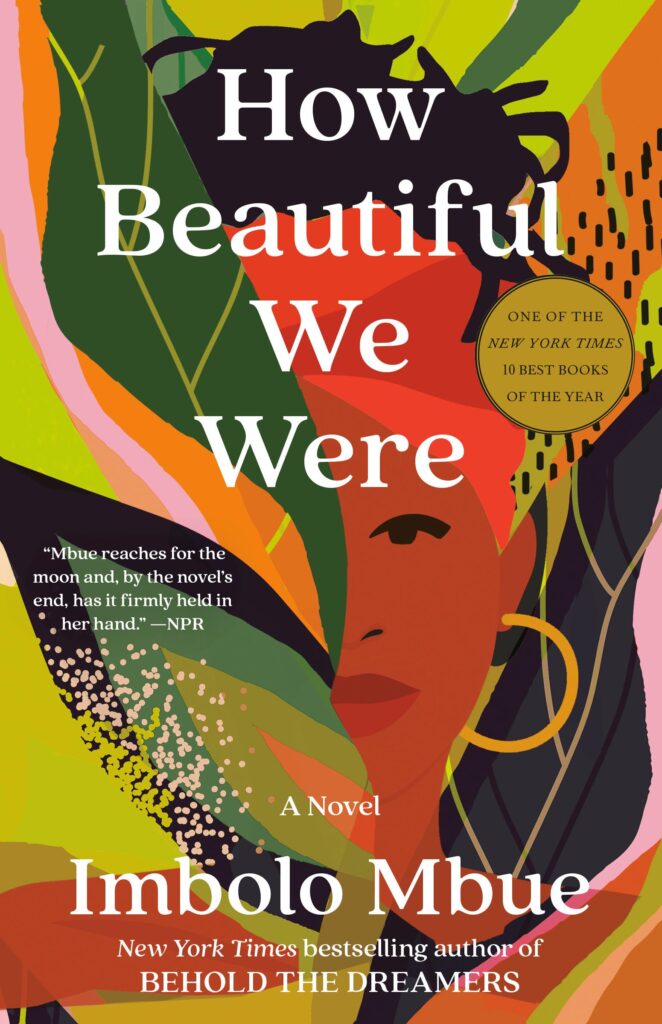
Cameroonian author Imbolo Mbue’s novel How Beautiful We Were (2021) is not technically cli-fi, because it does not take place in the future. Even so, it deserves consideration since it makes the connection between long-term socio-ecological breakdown, food and food security abundantly clear. In other words, it tells the history that much other cli-fi builds on, even as many examples of this genre fail to integrate this history into the narrative. In addition to this, the novel provides the reader with a unique understanding of what it is like to live in the extractive peripheries of what Andreas Malm has termed fossil capital.
How Beautiful We Were traces the history of the entry and evolution of the oil economy in Cameroon, from the late 1970s to the present day. What sets the novel apart from texts such as Helon Habila’s widely studied Oil on Water is this long historical perspective, but also the fact that the story is told by several different narrators who understand the violence exerted by the oil industry through different systems of knowledge. All voices in the novel belong to members of the village of Kosawa, located along a river several days from the coast. The primary perspectives belong to members of an extended family from this community: a grandmother, her children and their spouses, and the grandchildren these couples produce. These voices are complemented by “the children”. At the beginning of the story, this is a collective of precisely small children, but during the course of the novel, they grow up to become adults, parents and grandparents.
The different yet strongly related perspectives provided by the novel help the reader understand how extremely detrimental the extraction of oil in this region is to this indigenous community. In fact, such extraction is even more detrimental to the village than the seventeenth and eighteenth-century slave trade or rubber extraction during the early twentieth century. This is because, unlike these previous forms of extraction, as horrific as they were, oil ruins the villagers’ ability to feed themselves. This is made clear from the opening passage of the novel, a scene where the villagers meet representatives of the American Paxton company (the name the novel uses in place of ExxonMobil, which extracted oil from Cameroon up until 2022). This company is in charge of extracting oil on Kosawa land, and the meeting is one of many conducted by the village in the hope of making Paxton stop polluting the region. Such pollution has led to “siblings and cousins and friends” having “perished from the poison in the water and the poison in the air and the poisoned food growing from the land that lost its purity the day Pexton came drilling.”
Importantly, the loss of nourishing food is also the loss of cultural and social cohesion. In this novel, to eat in certain ways is not only to feed the body, but also to situate yourself with your community and your culture. This is made clear in a passage where a young woman named Thula narrates her experience of a feast:
Mama tells me that she has prepared my favorite meal—fried ripe plantains and beans with smoked pig feet. Across Kosawa, mothers have prepared special meals for their families, as if the simple day deserved celebration. They’ve cooked rice and smoked-goat stew; leafy greens steamed with palm oil and mushrooms; boiled yams to go with okra sauce and bushmeat. The meals are made from ingredients both pure and adulterated, some from our dying farms and emptying barns, most bought at the big market, paid for with a portion of whatever the women earn from selling the animals their men kill in the forest. Some dishes are made possible by the benevolence of relatives with fertile lands who live in other villages, aunts and grandmothers and cousins many times removed who occasionally visit and offer us foods they still have in abundance.
As the destruction of the Kosawa land continues, this way of eating and belonging becomes increasingly difficult. Paxton keeps promising to limit their environmental impact, to gather the waste spilt into the land and the river, and to compensate the village for the suffering it has already caused. Over the forty years the novel covers, these promises are never realised. Instead, the extractive violence increases and the land continues to deteriorate. Villagers who resist are ignored, imprisoned or killed.
The novel also notes similarities between the situation in Cameroon and other peripheries across the world system. Thula gets the opportunity to travel to America to study. There, she reads Karl Marx and Frantz Fanon, and also discovers that other indigenous communities have experienced the same injustices:
One man stood up and spoke of a place many days’ travel by car from New York, this place has pipelines too. The pipelines are not spilling like ours, but the people there do not want them crossing their land, they say pipelines are a calamity waiting to happen. Their government disagrees, so these people have to live with the pipelines just as we have to. Pipelines, in America—can you believe such a thing? The pipelines here run under the ground, but the people say it doesn’t matter—simply having them deprives their land of its sanctity. But their government is not concerned about the sanctity of their land.
In these ways, How Beautiful We Were makes it clear that land justice and food justice, land security and food security, and food access and cultural access, are inseparable. This is important to keep in mind in any discussion that involves food, the food system and the future of the planet. The 2025 EAT Lancet Commission report identifies “justice” as central to the effort of making the food system sustainable. Through its long historical view and its perspective from the extractive periphery, How Beautiful We Were demonstrates clearly what neglecting justice means for people who have rarely been invited to speak. At the same time, it marks an entry of such a voice into this very conversation.