
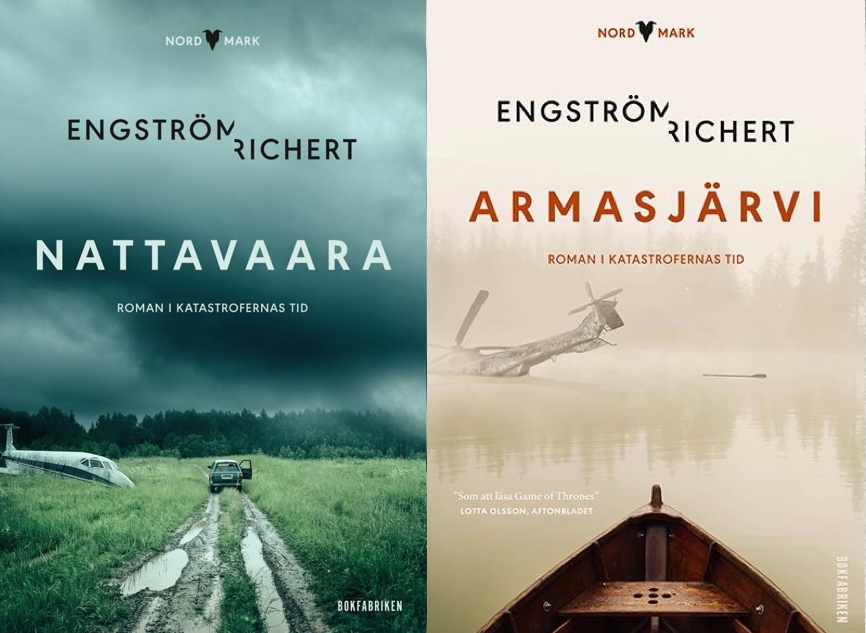
Two of the most ambitious cli-fi novels in Swedish are Nattavaara (2020) and Armasjärvi (2021) by Margit Richert and Thomas Engström. Both books carry the subheading “Novel in the Time of Disaster” (Roman i katastrofens tid) and take place in what is today northern Sweden. However, this nation-state has, following substantial socio-ecological chaos, been divided into a number of smaller formal and informal states. The main characters of the story belong to one of these new political entities, a region called Nordmark, with its centre of government located in the city of Kiruna. As in many similar texts, the far north is imagined as comparatively temperate in this future, less prone to drought, forest fires and debilitating heat waves. Even so, it is still a hostile place. The government is corrupt and/or on drugs, people in the periphery starve and compete for scarce resources, and climate refugees from the south are turned into indentured servants.
Unlike some other cli-fi, the two novels tell the story of how the disaster that has shaped this future came about. This is partly done through the construction of the characters, many of whom were once upon a time working towards careers that the reader is likely to recognise: doctors, psychologists, diplomats. These characters tend to look back towards a world that allowed for such careers, and they consider why this world is now gone. The story of the drivers of socio-ecological disaster is also told via news items published between today and the time of the novel. Via the stories narrated by the characters of the novels, and through these increasingly alarming news reports, the reader is able to piece together the history that separates the future of the novels from the present. This is a history where the melting of the Arctic ice causes nations states to scramble for resources laid bare, the UN collapses due to right-wing terrorist action, the Amazon forests is on fire, 70 million people flee starvation and violence in Africa, where Amazon (the corporation) is “buying up” refugees to use for cheap labour in company towns, and where still airborne satellites project “Pepsi” or “Huawei” on the moon before an audience now mostly unable to consume the products these mega corporations are selling.
As in much other cli-fi, this story of both slow and fast human/ecological violence is told via images of food and eating, and through descriptions of a collapsing global food system. To first consider the system, the world-food-system as we know it today has gone defunct in the novel, forcing people in Nordmark and across the world to grow their own food. This has clearly been a tremendous challenge for people. According to the Federation of Swedish Farmers, Sweden currently produces about 50% of all the food consumed within the nation and currently lacks the ability to significantly expand this percentage. Thus, it is not strange that the food-system transformation people in the novel have experienced has been largely unsuccessful, leaving people to experience debilitating food scarcity and starvation.
To consider the question of food and eating, the novel pays particular attention to the diets and dishes that this new and far more local food system makes possible. At the opening of the novel, Erik and Sofia, two children born into this new world, are making a sparse meal out of turnip soup. In another part of Nordmark, a middle-aged woman named Marja is counting broad beans, anticipating the sprouting of edible nettles, and hoping that her husband finds feed for the chickens that have survived the winter. She can remember a time when food was plentiful, and this has made her experience of food scarcity even worse: “Not starvation, not again. She could not bear it. She could not bear the constant hunger, the hair falling off in large clumps, the gums that never stopped bleeding, the nerve pains in the legs”.
The point of these descriptions is to convey an image of what starvation is like to a reader who, in most likelihood, has never experienced it. At the same time, these passages also highlight the fact that a food system transformed by socio-ecological breakdown will not only be short on food, but it will also lack variety and taste. In Kiruna, where the seat of government sits, food is more plentiful, but still severely limited when it comes to gustatory potential. There is a fairly constant supply of “meat, potatoes, onion, and cabbage”, but little else. To bring home this point, Marja has saved a small jar of curry powder, waiting for a day when she might dare to consume one of her young roosters in the hen house. This is her dream of a day, not just of plenty but of a renewed encounter with a global gustatory heritage.
While food scarcity and food insecurity are obviously much more dire effects of socio-ecological breakdown than the loss of certain gustatory experiences, this is still an important point to make. A local and isolated food system is unlikely to be able to deliver the same kind of taste experience as the existing one. Thus, and in accordance with much other cli-fi from the Nordic region and North America, it explores a food imaginary that is not only related to food access, but to food’s gustatory potential. In essence, these novels suggest that the future will be disastrous not just because food will be difficult to come by, but also because it will be incredibly bland.This does not mean that Nattavaara and Armasjärvi are proposing, as some cli-fi arguably does, that the old foodways must be preserved at all costs. The two novels clearly identify unbridled capitalism as the driver of socio-ecological breakdown, so a point made is that the old foodways – the capitalist world-food-system – cannot be preserved since it is a main driver of socio-ecological breakdown. When the system collapses, so will certain gustatory experiences. What is perhaps unfortunate is that the two novels offer little hope. Like much other dystopian cli-fi, the point of the texts is to introduce the reader to the world that awaits if radical action is not taken. While this arguably serves a purpose, it does not provide the reader with many ways of thinking beyond the system. It would be interesting to imagine what gustatory experiences a future sustainable food system – one that caters to people’s nutritional and gustatory needs, rather than to the demand to accumulate wealth – may look like.